








Australia’s most critical industries, including mining, ports, transport and aviation, are under growing pressure to push operating assets beyond their intended lifespan to avoid the immense cost of replacement, but not without risks.
Cracks, structural deterioration and hidden corrosion can develop deep inside ageing pipelines, processing equipment, massive stacker reclaimers and rail systems, often going undetected until they cause dangerous failures, safety incidents or multi-million-dollar shutdowns.
Engineering, project delivery and professional services firm Hatch says heavy industries have long required a new generation of industrial inspection technology to solve the problem.
The challenge comes as companies face tighter margins and pressure to keep equipment running longer, even amid the risks of straining ageing infrastructure, from conveyor collapses in mining operations to major structural failures that have caused injuries and significant operational disruption.
The most serious problems can develop slowly and out of sight, leaving operators with little visibility of what is happening inside critical assets, from aircraft components and pipelines to blast furnaces, smelters and rail systems, until it is too late.
Hatch research shows the issue persists because traditional inspection methods are unable to detect deterioration developing deep within complex industrial assets.
While Low Frequency Pulse Ultrasonic (LFPU) systems are already used to address this, Hatch says they need to go further by assessing the walls of complex structures through three, four or more layers.
Simon Nitschke, Hatch’s Brisbane-based Managing Director of Technologies, said conditions have shifted.
“The engineering challenge is no longer simply keeping assets running longer, it’s understanding how those assets are ageing while they remain in operation,” he said.
Hatch has spent more than a decade refining this approach in the field. Its low-frequency ultrasonic technology, known as StaveCheck, has already been used across the global steel industry to monitor dozens of operating blast furnaces, where cooling staves wear unpredictably, and undetected failures can be catastrophic.
The technology measures the thickness of furnace staves through the steel shell and refractory lining from outside the furnace.
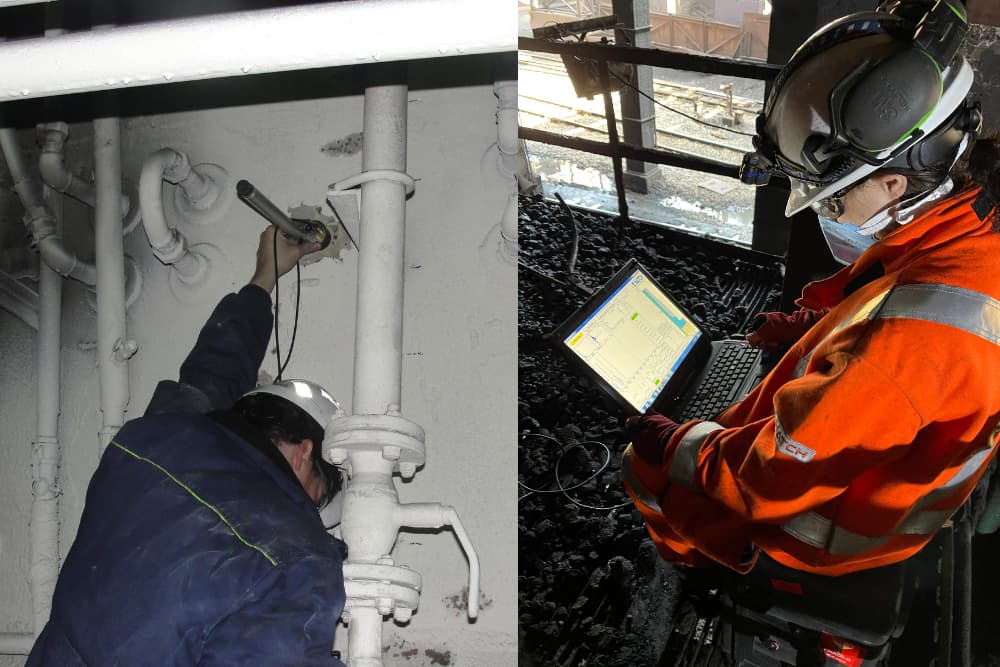
Launching this month, LayerSense is billed as the next generation of that technology. It draws on advanced non-destructive testing tools, structural monitoring systems and sophisticated data analysis, allowing engineers to continuously check the integrity of a broader range of industrial and infrastructure assets deep within their walls.
The system sends low-frequency ultrasonic pulses through an asset while it remains in operation, then analyses how those signals return to measure internal layers and detect corrosion and cracks forming beneath the surface. Because the pulses are tuned to penetrate dense, multi-layered materials, LayerSense can assess total wall thicknesses of up to 600mm and single layers from around 10mm, with an accuracy within 2mm.
Afshin Sadri, Hatch’s technical lead on the project and the inventor of LayerSense, said the technology could help operators plan around maintenance rather than react to failures.
“LayerSense differs from conventional industrial ultrasonic systems in the way its ultrasonic pulses are generated and received, allowing it to measure through complex structures with three, four or more layers,” he said.
The technology has already proven itself in the field. At BHP Nickel West’s Kalgoorlie Nickel Smelter in Western Australia, operators had long relied on temperature sensors to monitor the high-temperature lining inside the smelting furnace, but those sensors could not detect the cracks and internal separation slowly developing within the lining itself.
Hatch was brought in to scan the furnace with its ultrasonic technology, tracking its condition over about six years and pinpointing exactly where the lining was cracking, roughly three years before the damage could have threatened the furnace’s structure.
A subsequent repair during a planned shutdown confirmed the location of the cracking and validated the accretion build-up levels Hatch’s inspections had reported throughout the monitoring campaign.
The early warning allowed BHP to schedule repairs before the furnace failed, avoiding extensive damage to the furnace and the equipment and infrastructure surrounding it.


