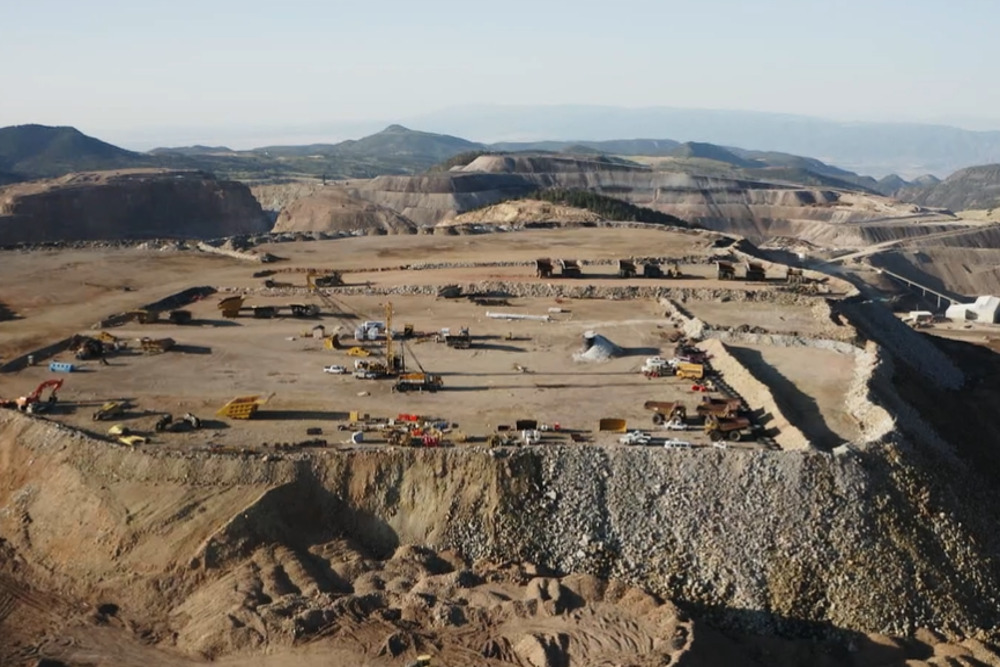
During Vertical Events’ recent RIU Resurgence Conference in Perth, it was described as one of the largest underdeveloped gold mines in Australia.
This observation came from Andy Beckwith, technical director for De Grey Mining Ltd (DGM), and he was of course talking about the highly anticipated Mallina project in Western Australia’s Pilbara.
While Beckwith was keen to look at the numbers which appear in the company’s recently-released pre-feasibility study (PFS) for Mallina, he didn’t mention one obvious potential corporate development which is likely to rear its head sometime in the future – a possible takeover bid by WA mid-tier yellow metal producer Gold Road Resources Ltd (GRR).
Back in August, GRR announced its plan to increase its stake in DGM, raising its dominant holding from 15.32% to 19.99%, a strategy that was set in stone during October.
At the time, the modest gold miner made what was a peculiarly coy statement to the market about its intentions, saying the boost in its shareholding was a “long term investment” and it “did not intend to make a takeover bid or other offer” for DGM, but “reserves its right to do so and to make further investments in DGM at any time” – this despite the fact it has described the transaction as a “takeover” in subsequent investor powerpoint presentations.
For its part, De Grey said it “notes the statement” made by GRR “in relation to its current intentions”, but would continue to focus on the delivery of its strategy to become a tier one gold producer at Mallina.
Then, during early October in a further piece of intrigue, the Pilbara explorer announced it had launched a fully underwritten institutional placement to raise $130 million and announced a non-underwritten share purchase plan targeting $20 million, for total equity raising proceeds of $150 million (before costs).
Amongst other things, this funding would underpin the completion of a definitive feasibility study (DFS) in preparation for a subsequent final investment decision, pay for further resource definition drilling and appropriate technical studies to increase project reserves, bankroll discovery and extension drilling targeting new discoveries and additional resources as well as allow pre-development activities.
Located around 85 kilometres south of Port Hedland, Mallina has a current mineral resource of 250.7 million tonnes of ore grading 1.3 grams per/t gold for 10.6 million ounces, as well as a reserve of 103.4 Mt at 1.5 g/t for 5.1 million oz.
These figures were determined after DGM, which is now an ASX-200 company, completed just over a thousand kilometres of drilling in the past three years (450 km of aircore, about 450 km of RC and 130 km of diamond) – an equivalent distance being that between the WA capital of Perth and the iron ore producing town of Newman in the East Pilbara.
In September’s PFS the results presented were quite compelling; certainly they are interesting enough to attract the interest of a number of current mid-tier gold miners hoping to expand their asset base.
As it stands Mallina is looking to be a low cost operation and should be a top five Australian yellow metal producer within the next five years.
Overall, the mine plan, including the regional deposits, assumes a 6.8 million gold oz inventory within 137 Mt of ore grading 1.56 g/t.
The jewel target of the project – Hemi, which was discovered just over three years ago and now contains two thirds of the project’s total resource – hosts an estimated 114 Mt at 1.54 g/t for 5.06 million oz at a 6:1.1 waste ore ratio.
At the moment some 90% of Hemi’s material is estimated in the current ore reserve. An open pit is only being considered at this stage.
In terms of processing, the plan is to run 10 Mt per annum through the circuit, resulting in 800,000 tpa of flotation concentrate, which will then be pressure oxidised ahead of carbon-in-leaching (CIL) along with the flotation tails.
Meanwhile, capital costs are estimated at just over $1 billion, with $68 million of this being put aside for the pre-strip.
Estimated processing expenses are $24/t, while mining costs come in at $31/t based on the rates available during mid-2022.
DGM expects its gold output for the first 10 years will be 540,000 ozpa, with a peak of 600,000 oz in year five. Metallurgical recovery is projected at 93.6%.
The DFS is now expected at the end of next year, construction is anticipated to take place between 2023 and 2025, with production scheduled to begin during the latter year.
In his recent review of the company, Argonaut Funds Management’s veteran gold analyst John Macdonald said the projected flotation performance, and oxidation/CIL recoveries from all ore types and sources, were “very good” at tolerable costs, “and that may be an area that potential financiers and acquirers will want to bed own”.
Moreover, he made a prediction regarding a possible takeover.
“We think a group will eventually pay up for control of Mallina, because Hemi’s long life, high volume potential transcends gold price and cost inflation concerns,” Macdonald noted.
During his RIU presentation, Beckwith suggested Mallina enjoyed plenty of upside as the company “ still have to put the regional deposits into the reserves, so we will probably be looking at, based on the PFS, a million oz of reserves hopefully coming out of there – that sort of order of magnitude”.
“And probably more important for many others, and including ourselves, the Pilbara is now a gold destination, not just an iron ore destination or (one for) lithium,” he noted.
No doubt GRR, which currently has mining and exploration assets east of Laverton in WA, would love to get its hands on the springboard which could bounce it into Australia’s newest, and highly prospective, gold province.